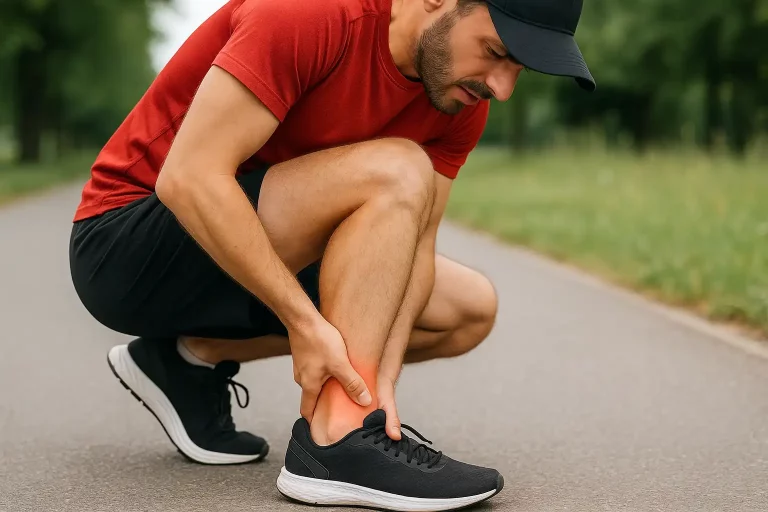

If you notice pain deep in the calf during or after a run, the timing is useful information but it does not identify a soleus injury. Record what happened, stop rather than repeatedly test a worsening symptom, and consider whether medical advice is needed. A careful account of one session can be more useful at an appointment than guessing which muscle is responsible.
This guide is about reporting symptoms and choosing the next step. It does not provide a diagnosis or a running programme.
Key takeaways
- “During” and “after” describe timing, not a confirmed injury.
- Record changes in function and associated symptoms, not just a pain number.
- You do not need another test run to produce a useful symptom diary.
- A routine injury appointment is inappropriate when urgent medical symptoms are present.
When to seek urgent medical help
One-sided calf pain and swelling, particularly with warmth or a change in skin colour, can indicate DVT. Seek urgent GP or NHS 111 advice if you suspect a clot. If calf symptoms occur with chest pain or breathlessness, call 999 or go to A&E and do not drive yourself. Running earlier that day does not rule out a medical cause. See NHS guidance on DVT.
A sudden severe pain or a snap followed by marked difficulty walking or pushing off also requires prompt medical assessment. Do not stretch, massage or run again to find out whether it is serious.
Make a record of the session you have already done
Start with facts you can remember. You do not need perfect distance or pace data. Use a map, watch record or diary if available, but do not allow missing information to delay care.
- Before: was the calf already uncomfortable during ordinary walking or before leaving home?
- First symptom: roughly when did you notice it, where did it feel uncomfortable and what were you doing?
- Function: did you stop, limp, shorten the run or change the way you moved?
- Afterwards: what happened during walking home, later that day and the next morning?
- Associated changes: record swelling, altered skin appearance, numbness or other new symptoms and report them appropriately.
Keep the record descriptive. “I felt an ache as I turned onto the path” preserves uncertainty. “My soleus tore because my shoes are wrong” adds a diagnosis and an explanation that have not been established.
A fictional diary example
The following is invented to illustrate reporting. It is not a clinic patient, a characteristic soleus pattern or evidence that these symptoms are safe.
Session: a planned easy run around a familiar loop. Observation: an ache appeared in the lower calf partway round. Decision: the runner stopped instead of completing the loop. Later: they noticed discomfort on stairs. Question for assessment: what might explain the symptoms and what activity is appropriate now?
The diary has done its job without identifying a muscle. It also separates what happened from what the runner wants next: perhaps walking comfortably to work before considering another run.
Does pain after a run mean something different?
Tell the assessor whether symptoms began during activity, afterwards or the next morning. Also explain whether this is new, repeated or changing. Timing can guide questions, but it cannot distinguish all muscular, tendon and medical causes on its own.
Do not turn “it eased after warming up” into proof that continuing is safe. Similarly, a delayed ache should not automatically be labelled harmless soreness. If symptoms are unusual for you, worsening or affecting normal movement, arrange appropriate advice.
Stopping is different from deciding the diagnosis
You can stop a session without knowing the cause. If discomfort is increasing, altering how you move or accompanied by concerning symptoms, finishing the planned distance does not help establish the explanation. Decide how to get home safely and use the appropriate care pathway.
For an already assessed injury, follow the individual activity and symptom instructions agreed with your clinician. New or different symptoms may need reassessment. An online guide cannot provide a universal pain score that makes another run acceptable.
Keep the next appointment focused
Bring the diary and explain your main question. “What do I need to understand before running again?” is a more useful starting point than asking for one exercise before the symptoms have been assessed.
The soleus pain overview explains the wider assessment pathway. Once an injury is established, use the rehabilitation exercise guide, recovery milestones and return-to-running discussion guide for separate questions.
The clinic also has an existing article about recurring calf and soleus strains. It covers a different question; its exercise examples should not be treated as a prescription for a new, unassessed symptom.
Frequently asked questions
Does pain after running identify a soleus injury?
⌄
⌄
Must I record a pain score?
⌄
⌄
Should I run again to see if it happens?
⌄
⌄
What if I have an event approaching?
⌄
⌄
Use the log to make one decision
For a clinician, the value of a running log is in the sequence. An ache that began after a faster section, changed your stride and lingered on stairs gives useful detail even if you have no pain score. Write down what actually happened on your last outing. There is no need to reproduce the symptoms for a more complete entry.
| What happened | What to note | Next action |
|---|---|---|
| Calf pain built and changed your stride | Where in the session it started, what you were doing and how walking felt after stopping | Stop the run and discuss recurring or persistent symptoms before another test |
| Discomfort appeared later on stairs | What you ran and how ordinary walking and stairs felt that evening and the next day | Bring the sequence to review and ask what activity is suitable meanwhile |
| New unexplained one-sided pain and swelling | When it started and any other symptoms, if you know | Seek urgent GP or NHS 111 advice if you suspect a clot. Call 999 if you also have chest pain or breathlessness. |
- Stop when symptoms change your movement or make continuing unsafe. Use the urgent advice above if warning signs are present.
- Write the account from memory. Include terrain, pace changes and other demanding activity that day.
- Ask at assessment what activity is appropriate while the problem is being clarified and when to review.
- If a return to running is appropriate, agree the first session and decide what response would prompt you to stop, repeat or seek another review.
If a race is close, bring the course, surface and distance to your appointment and discuss your options before making a decision. A record can help your clinician plan appropriate activity. NHS advice on deep vein thrombosis
Discuss running-related symptoms
For non-urgent symptoms, explore running injury assessment at The Recovery Room. Bring your account of the symptoms and the activity you hope to resume.
References
- NHS: DVT
- Green and colleagues, 2022: expert clinicians' approaches to calf injuries
- Pedret and colleagues, 2026: calf injuries
The previous version was clinically reviewed by James Kirkpatrick, MSc Sports Therapy, on 29 October 2026.